


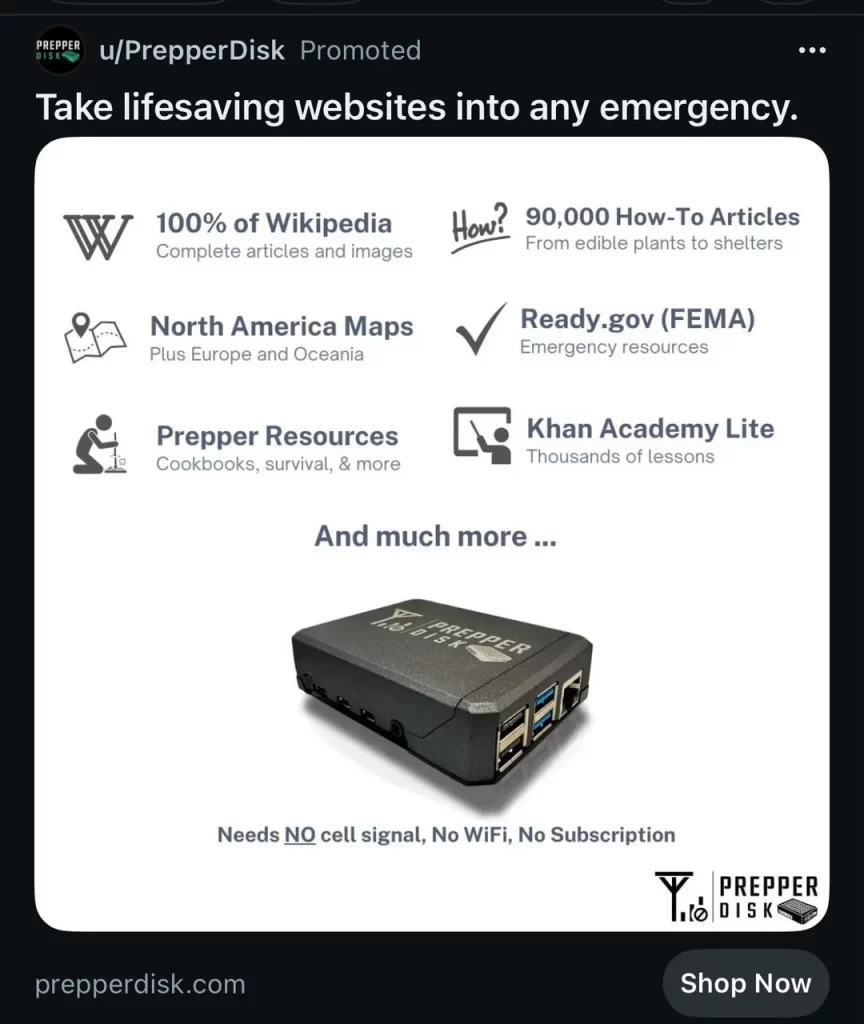
 No doubt this is a reflection of the subs I browse, but I frequently see ads for the PrepperDisk.
The PrepperDisk – “Knowledge that Survives the Storm” – is a Raspberry Pi that has been kitted out with a few features:
- Local wi-fi router so you can connect to it with your phone, tablet, laptop, etc.
- Complete downloads of many freely available resources, such as Wikipedia, FEMA, various maps, etc.
- A zero-management, appliance model of presenting this information. You plug it in, connect with whatever client you want, and browse. You don’t need to be an engineer or computer wizard to use this device.
This idea is intriguing, though I think the utility is a little oversold.
Real World Disasters
Portland, Oregon is on a fault line and there will someday be an earthquake here. Let’s take that as a baseline scenario. If tomorrow there was a massive earthquake, the bridges would collapse, turning the city into various pockets of isolated areas that are only navigable by foot. Realistically, the citizenry would be on its own for some period of time until the arrival or FEMA and/or the United States Marine Corps (this is Portland, after all).
Now, keep in mind that the government has not fallen, nor have the North Koreans invaded. So while there will be a lot of short-term inconvenience, help is on the way from the start. You don’t need to know how to survive for decades, just long enough to be reconnected to society and your insurance adjuster.
There are many things you might need, ranging from food and water to emergency medical supplies to a good boomstick. But how much information do you need?
I’m not sure having 100% of Wikipedia will be all that helpful. Electricity will be out in all likelihood, as will natural gas, so you won’t need to repair those systems if they’ve broken. You’re not going to learn to fish from a book, and the real fishermen will swiftly decimate the local rivers anyway. There are some core survival skills that everyone should have, such as how to purify water and basic first aid, but I don’t think you need a massive library for that information.
Now, I’m not saying having info is useless. When I used to work downtown, I realized that if there was an earthquake, I would need to walk the 12 miles to my home, stopping at my daughter’s school on the way. Keeping a “go bag” at my desk, which included street maps, made a lot of sense, as did having a duplicate in my car’s trunk. The street maps were a useful information resource. But I would be hard pressed to name any other information resource I needed when I got home.
My core belief is that while more information is always good, when it comes to survival, you need the information well in advance and the preparations to go along with it.
Of course, depending on what scenario you’re planning for, keeping all this info on a relatively fragile consumer electronic device may not be ideal. There’s all sorts of environmental hazards, from floods to EMP, that could make this…well, it’s too light to be a brick but you get my point. And while SDs can last a long time, bit rot is real and eventually it’s going to fail.
Still…C’mon, It’s a Cool Idea
I have to admit, the kid-who-grew-up-in-1980s-survival-mania in me still thinks it’s a neat idea. All that information at your fingertips…
Having these kinds of resources may make more sense in a End of the World scenario, but so much of the information depends on preplanning and available supplies. You might know how to plant and raise corn, but you’re going to need good topsoil, seeds, tools, and cooperating weather to pull that off. Recognizing someone has a serious infection without a supply of antibiotics isn’t that useful. Etcetera. Still, I remember in all those “how to survive nuclear war” books I read in the 80s, there was always a list of books to have on hand.
I think scenarios that don’t involve desperate survival might be a better use case for this product. For example, you’ve rented a cabin and are staying there for a month, but there’s no cell signal and no Starlink. Having a catalog of documentation on major electric and plumbing systems, local mushrooms your dog might accidentally eat, recipes to prepare venison, etc. could be handy.
So do you need to spend $200 for one of these if you want this type of device.
Need? No. Nearly everything else on the PrepperDisk is publicly available (ready.gov, etc.). Their FAQ has a Q titled “Could I make my something like this on my own?” and kudos to them for answering it honestly. They point out some of their advantages:
- They include some licensed books that are not available for general download.
- They’ve spent time curating/smoothing out the information so maps, government docs, etc. are neatly organized.
- They’ve done the engineering on the case and testing everything.
So it’s like a lot of DIY scenarios: you can either spend money or your time.
Resources to check out if you want to DIY are Internet-in-a-Box, Kiwix and Rachel.
Pro Tip: this info source has a very limited life time unless you have solar power. I don’t mean your roof system, which may very well be damaged in a quake. I mean some sort of portable solar generation, like a solar-rechargeable USB battery. Granted, those are pretty cheap now so you should provision one if you go down this route.
Have you built something like this? Or do you own a PrepperDisk? Let us know your thoughts in the comments below!

raindog308 is a longtime community LETizen, technical writer, and self-described techno polymath. With deep roots in the *nix world, he has a passion for systems both modern and vintage, ranging from Unix, Perl, Python, and Golang to shell scripting and mainframe-era operating systems like MVS. He’s equally comfortable with relational database systems, having spent years working with Oracle, PostgreSQL, and MySQL.
As an avid user of LowEndBox providers, raindog308 runs an empire of LEBs, from tiny boxes for VPNs, to mid-sized instances for application hosting, and heavyweight servers for data storage and complex databases. He brings both technical rigor and real-world experience to every piece he writes.
Beyond the command line, raindog308 has a life-long love of German Shepherd Dogs, high-quality knives, target shooting, theology, tabletop RPGs, playing guitar, and hiking in deep, quiet forests.
His goal with every article is to help users, from beginners to seasoned sysadmins, get more value, performance, and enjoyment out of their infrastructure.
You can find him daily in the forums at LowEndTalk under the handle @raindog308.






















Leave a Reply