


 Yih-Shyan “Wally” Liaw, one of the founders of server manufacturer SuperMicro, has been indicted on charges of smuggling billions of dollars’ worth of high-end Nvidia GPUs to China.
As alleged in the Indictment, the defendants participated in a systematic scheme to divert massive quantities of U.S. artificial intelligence technology to customers in China,” said U.S. Attorney Jay Clayton. “They did so through a tangled web of lies, obfuscation, and concealment—all to drive sales and generate revenues in violation of U.S. law. Diversion schemes like those disrupted today generate billions of dollars in ill-gotten gains and pose a direct threat to U.S. national security.
SuperMicro (NASDAQ:SMCI) stock sank 33% on the news.
Liaw is still on the SuperMicro board of directors.
Mr. Liaw co-founded the Company in 1993. From the Company’s founding until January 2018, Mr. Liaw was an employee and held various executive positions in the Company, including Senior Vice President of Worldwide Sales and Corporate Secretary and was a member of the Board of Directors. From June 2020 until April 2021, Mr. Liaw was the president of 2CRSi Corporation, a company headquartered in Strasbourg, France that develops, produces and sells high-performance customized, environmentally-friendly servers. Mr. Liaw returned to the Company as a consultant in May 2021, advising the Company with respect to business development matters. In August 2022, Mr. Liaw returned to full-time employment with the Company as Senior Vice President, Business Development.
The scheme involved Liaw and others getting orders from Chinese customers, then placing orders with US companies (SuperMicro?) and receiving the goods. They then repackaged the servers and GPUs to conceal what was inside the boxes and shipped them on to China.
The scheme operated as follows. LIAW and CHANG, who worked closely with third-party brokers with customers based in China, directed certain executives of a company based in Southeast Asia (“Company-1”) to place purchase orders with the U.S. Manufacturer for servers with certain GPUs, purportedly for Company-1. Those servers were often assembled in the United States and shipped to the U.S. Manufacturer’s facilities in Taiwan, then delivered to Company-1 elsewhere in Southeast Asia. Company-1, in consultation with the defendants, then used a shipping and logistics company to repackage the U.S. Manufacturer’s servers and place them in unmarked boxes to conceal their content prior to shipping them to their final destinations in China. To ensure that these server allocations were approved internally at the U.S. Manufacturer, the defendants and executives at Company-1 prepared false documents and records, and transmitted false communications, purporting to show that Company-1 was the end user of the servers.
The defendants and their co-conspirators took extensive measures to conceal their scheme. As just one example, to deceive the U.S. Manufacturer’s compliance team, responsible for ensuring adherence to U.S. export control laws, the defendants staged thousands of “dummy” servers—non-working, physical replicas of the U.S. Manufacturer’s servers—for inspection at the locations where Company-1 was purportedly storing the servers it had purchased from the U.S. Manufacturer.
The press release photos show the scale of this massive operation, which involved $2.5 billion dollars’ worth of gear.
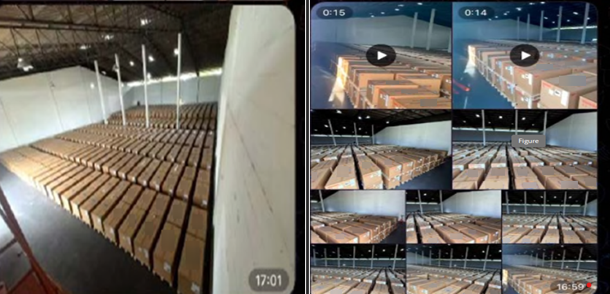
Assuming all of these facts can be proven, it’s going to be hard for the defendants to claim innocence. They clearly purchased, repackaged, and shipped products – billions’ worth – in defiance of export controls, and they lied to the government about it.
Related Posts:
BitsFlowCloud: Get a 2GB VPS in Germany for Just £8.40/YEAR! Asia-Optimized Network to China Availa...
Not So Fast, Tovarisch: Can a Westerner Legally Buy a Russian VPS?
JustHosting: Growth Story, Service Philosophy, and Future Vision — An Interview with Founder Anton P...
Exotic Locations: Where the Datacenters are, from a LowEnd Perspective
BLACK FRIDAY: Just Hosting Has Cheap VPS Offers in 38 Datacenters for You!
SuperMicro Under Siege: Auditor Resigns Because of Sketchy Financials, Stock Plunges

raindog308 is a longtime community LETizen, technical writer, and self-described techno polymath. With deep roots in the *nix world, he has a passion for systems both modern and vintage, ranging from Unix, Perl, Python, and Golang to shell scripting and mainframe-era operating systems like MVS. He’s equally comfortable with relational database systems, having spent years working with Oracle, PostgreSQL, and MySQL.
As an avid user of LowEndBox providers, raindog308 runs an empire of LEBs, from tiny boxes for VPNs, to mid-sized instances for application hosting, and heavyweight servers for data storage and complex databases. He brings both technical rigor and real-world experience to every piece he writes.
Beyond the command line, raindog308 has a life-long love of German Shepherd Dogs, high-quality knives, target shooting, theology, tabletop RPGs, playing guitar, and hiking in deep, quiet forests.
His goal with every article is to help users, from beginners to seasoned sysadmins, get more value, performance, and enjoyment out of their infrastructure.
You can find him daily in the forums at LowEndTalk under the handle @raindog308.




















Leave a Reply