


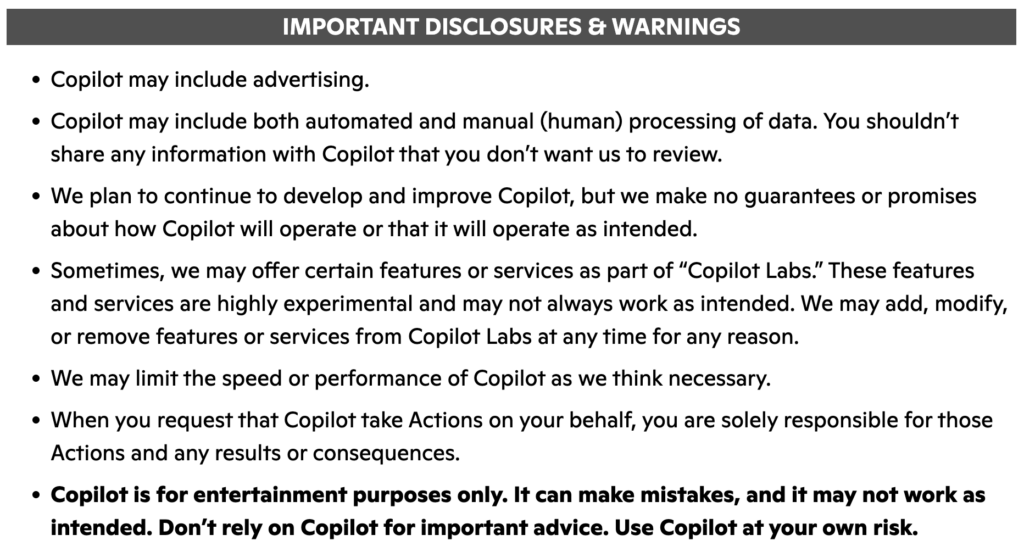
 Don’t believe me? Just look at the Microsoft Copilot terms of use:
Copilot is for entertainment purposes only. It can make mistakes, and it may not work as intended. Don’t rely on Copilot for important advice. Use Copilot at your own risk.
I read through the Copilot TOS and a lot of what it says are the usual “you don’t get to sue us” disclaimers. For example:
We may limit the speed or performance of Copilot as we think necessary.
When you request that Copilot take Actions on your behalf, you are solely responsible for those Actions and any results or consequences.
But to say it’s for entertainment purposes only is quite a spin. After all, this is the product Microsoft touts as transformational for enterprises, driving tremendous gains in productivity, blab blah blah.
It’s worth noting that Claude does not say it’s for entertainment purposes only. Nor does ChatGPT’s. Or Gemini’s.
So What’s the Deal?
My suspicion is that while every AI’s TOS says it “may generate inaccurate information” and “should not be relied upon for advice” and other such disclaimers, Microsoft went to the extreme of saying it’s for “entertainment purposes only” because they have so much consumer exposure.
Tons of people who’ve never logged into ChatGPT or Claude will fire up Word or Excel on their PCs. And that Copilot button is right there, offering to assist them. If it helps some teenager write a suicide note, Microsoft has massive exposure.
Related Posts:
Revisiting Turry: The Nightmare AI Extinction Event Scenario From 2015
"Would Say"? Why Are We Would-Saying, Sam Altman?
PortableMind: The Offline AI on a USB You Can Run on Your Laptop - Privacy, Survival Info, and More!
Alabama Attorney General Steve Marshall is Bashing the AI Industry to Help His Senate Bid
Stick to Code, Toaster: Has AI Gotten Any Better at Humor? Let's Rerun Our "Tell Me a Joke" Test
How to Get Sued Into Oblivion: Guardian Angel AI

raindog308 is a longtime community LETizen, technical writer, and self-described techno polymath. With deep roots in the *nix world, he has a passion for systems both modern and vintage, ranging from Unix, Perl, Python, and Golang to shell scripting and mainframe-era operating systems like MVS. He’s equally comfortable with relational database systems, having spent years working with Oracle, PostgreSQL, and MySQL.
As an avid user of LowEndBox providers, raindog308 runs an empire of LEBs, from tiny boxes for VPNs, to mid-sized instances for application hosting, and heavyweight servers for data storage and complex databases. He brings both technical rigor and real-world experience to every piece he writes.
Beyond the command line, raindog308 has a life-long love of German Shepherd Dogs, high-quality knives, target shooting, theology, tabletop RPGs, playing guitar, and hiking in deep, quiet forests.
His goal with every article is to help users, from beginners to seasoned sysadmins, get more value, performance, and enjoyment out of their infrastructure.
You can find him daily in the forums at LowEndTalk under the handle @raindog308.























Leave a Reply