


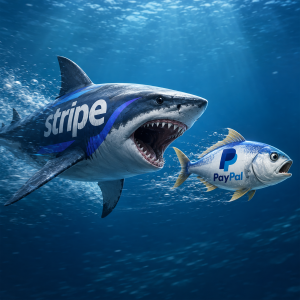
 Stripe made a bid in July to buy PayPal (NASDAQ: PYPL) for $53 billion. According to reports, they’d started looking at it in February – more on that in a moment, because it’s really important – and then started talking with them in April.
There’s always a dance with these sort of negotiations. Acquisitions rarely come out of the blue. Usually one CEO talks with another, starts feeling them out on price, etc. The bid was made privately in early July, and then leaked on July 14 when Reuters reported it.
At the time, the bid was for $60.50 a share, which as a 28% premium to PayPal’s pre-report trading price. If you were a PayPal stockholder, that was a nice deal. Over the last 5 years, PayPal’s stock has cratered. From a high in the $300s in 2021, it has sunk to the low $40s by February when Stripe started sniffing around. While some shareholders may look wistfully at those vaunted highs of five years ago, most at this point are sitting on massive losses. After a plunge in 2021, the stock has done little more than tread water since 2022. Meanwhile, the rest of the market has zoomed. Getting out with a 28% bump should be a dream for those stockholders.
Unfortunately for Stripe, the PayPal board considered the offer inadequate. They felt $53 billion undervalued the company. But they didn’t initially completely reject it, and left the room open for negotiation. In a classic acquisition scenario move, they released their Q2 results with greatly improved full-year non-GAAP guidance. Those numbers are simply what management thinks could happen. They’re not held to them, and there’s no auditing of them. They’re projections. But they make the company appear stronger.
PayPal’s stock improved, and by August 27 it was at $61.47. That’s well above the $60.50/share that Strip was offering. At this point, the board would never accept a $60.50/offer and if Stripe wanted to offer the same kind of premium, they’d be at $77.50ish per share. That pushes the deal to $66.3 billion.
So Stripe walked away. PayPal had gussied up the company’s stock to the point where the bid was no longer a premium. The board no doubt thought that Stripe would come back with a sweeter deal, but instead Stripe just closed the book. Oops.
Terminating the bid tells us that Stripe was primarily interested in PayPal as a distressed asset. They saw a competitor who was available for cheap. Integrating PayPal would have doubled Stripe’s payments volume (to nearly $4 trillion), and give it more international scope. This was mainly about a cheap way for Stripe to scale.
But then it was no longer cheap. You also have to factor into the equation:
- all the integration risk and headache
- how this would have consumed management for a year or two, meaning other strategic projects would be sidelined
- significant anti-trust risk and work, including probably divestment of PayPal’s Braintree payments gateway
So it’s not just $X billion but $X billion plus all the work and risk.
The sad thing for PayPal stockholders is that once Stripe walked away, there was no one else waiting to jump in. There’s no bidding war for PayPal. The board has made it clear that they want a lot of money for the company and decided to play financial chicken with Stripe. Now they have to continue going it alone. If I was a stockholder, I’d expect to see all those rosy predictions come true, otherwise I’d vote for a wholesale replacement of the board and CEO.
PayPal has a pitiful P/E of 10, and while they’re profitable, there’s no real growth trajectory. The stock has sank back to $54/share, where it’s likely to remain.
Next stop? Probably some kind of Carl Icahn-like figure will step in, buy a stake, and start pressuring the board to make radical changes. Or at least start proving that PayPal is worth a lot more than the market thinks it is.
Related Posts:
Get Quickly Banned From ANY Provider With This One Weird Trick!
Are PayPal Chargebacks Weapons of Mass Involucration? What Does a Chargeback Do to a Provider?
PayPal Attempts to Impose Random Fines, Lies When Caught
Bye-Bye PayPal Friends And Family Payments To Business Accounts!
LowEndBox TV Weekend Update for July 31, 2021
PayPal Rates Increasing on August 2nd

raindog308 is a longtime community LETizen, technical writer, and self-described techno polymath. With deep roots in the *nix world, he has a passion for systems both modern and vintage, ranging from Unix, Perl, Python, and Golang to shell scripting and mainframe-era operating systems like MVS. He’s equally comfortable with relational database systems, having spent years working with Oracle, PostgreSQL, and MySQL.
As an avid user of LowEndBox providers, raindog308 runs an empire of LEBs, from tiny boxes for VPNs, to mid-sized instances for application hosting, and heavyweight servers for data storage and complex databases. He brings both technical rigor and real-world experience to every piece he writes.
Beyond the command line, raindog308 has a life-long love of German Shepherd Dogs, high-quality knives, target shooting, theology, tabletop RPGs, playing guitar, and hiking in deep, quiet forests.
His goal with every article is to help users, from beginners to seasoned sysadmins, get more value, performance, and enjoyment out of their infrastructure.
You can find him daily in the forums at LowEndTalk under the handle @raindog308.




















Leave a Reply