


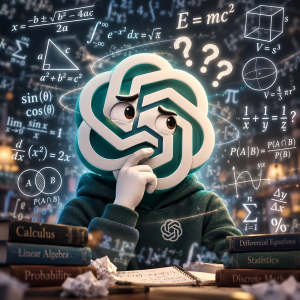
 As you my have read, recently OpenAI dropped a bombshell on the math community by posting proofs of 372 open problems. They were dropped all at once, in a massive GitHub dump.
The reaction from the math community was one of tremendous shock. You can read a collection of over 100 reactions from professionals in the field. Even if you don’t understand the lingo – and I certainly don’t – just the adjectives they use are telling:
- “almost unbelievable”
- “absolutely shocking”
- disorienting, exhausting, visceral”
- “devastating”
- “horrified”
Etcetera. Many have termed this “strip-mining” the math community because the models are skimming off the top of human creative thought and despoiling it.
I think people need to relax a little.
I’d like to point out three things which seem to be grossly under-emphasized.
First, the idea that a problem is solved is not the same as the community understanding it. OpenAI’s models did not present papers, give talks, or launch video presentations walking through the solutions. They just vomited out solutions. It’s vibe-coding for math. If you say to Claude, “vibe code me an ERP”, sure, you’ll get an ERP but someone still has to understand the code and maintain it. Math is different of course but humans still need to understand these solutions and integrate them into our collective knowledge.
“There is nobody at this company who could possibly give a talk or answer technical questions about any of these results.” – Northwestern University professor Bryna Kra
Having solutions dumped on you doesn’t automatically make them part of the math community. In fact, it’s the math community itself which decides what to let in. Maybe the math community should decide that since these papers are not explained – and by many accounts, not really argued out in a way a typical mathematician would understand according to the norms of the community – they should be processed differently.
Second, it’s worth noting the survivorship bias in these results. OpenAI dumped a bunch of papers (some of which it had to retract). It solved some problems…but it didn’t solve all problems, and I can guarantee it didn’t solve all the problems it attempted. It picked off the low-hanging fruit. If OpenAI could present a proof for the Riemann hypothesis or solve the P vs. NP problem – two problems so famous that even I have heard of them – then it would have done so. It only solved what it was capable of. Maybe there were 100,000 problems it couldn’t solve to get these 300-ish? What you’re seeing here are undeniably the easiest open problems.
Finally, it’s worth noting a key limitation: OpenAI only solved problems humans posed. It didn’t come up withe new problems or conjectures. I think this is really important and demonstrates convincingly that OpenAI’s model really aren’t doing any creative thought. They’re simply association engines that cross-referenced and applied some ideas – admittedly at a very high level – that humans hadn’t thought of yet. They did not truly advance the boundaries of math. Math doesn’t stop at “well, we have answers to all the problems”. It is constantly asking new questions, making new conjectures, and posing new issues to work on. OpenAI did none of that. They just zipped in, took the easiest 300 problems they could find, and dropped an egg.
Yes, these last couple weeks have been a big deal in mathematics and I can understand all the stress and angst. But math isn’t dead and it’s important not to let what is essentially – actually, entirely – an OpenAI PR stunt ruin your day.
Related Posts:
My Books Were Used to Train AI. How Should I Feel About That?
Revisiting Turry: The Nightmare AI Extinction Event Scenario From 2015
"Would Say"? Why Are We Would-Saying, Sam Altman?
Alabama Attorney General Steve Marshall is Bashing the AI Industry to Help His Senate Bid
AI Companies Are Destroying Every Old Book and Shredding Gutenberg Bibles and...Pump the Brakes, Peo...
I'm Sorry, Sam, What Did You Just Say? Altman Says No "AI Jobs Apocalypse" Coming

raindog308 is a longtime community LETizen, technical writer, and self-described techno polymath. With deep roots in the *nix world, he has a passion for systems both modern and vintage, ranging from Unix, Perl, Python, and Golang to shell scripting and mainframe-era operating systems like MVS. He’s equally comfortable with relational database systems, having spent years working with Oracle, PostgreSQL, and MySQL.
As an avid user of LowEndBox providers, raindog308 runs an empire of LEBs, from tiny boxes for VPNs, to mid-sized instances for application hosting, and heavyweight servers for data storage and complex databases. He brings both technical rigor and real-world experience to every piece he writes.
Beyond the command line, raindog308 has a life-long love of German Shepherd Dogs, high-quality knives, target shooting, theology, tabletop RPGs, playing guitar, and hiking in deep, quiet forests.
His goal with every article is to help users, from beginners to seasoned sysadmins, get more value, performance, and enjoyment out of their infrastructure.
You can find him daily in the forums at LowEndTalk under the handle @raindog308.



















Leave a Reply