


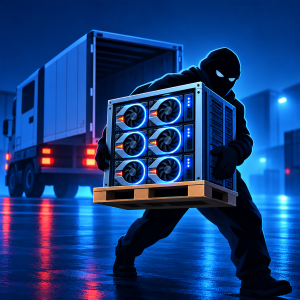
 Apparently, the AI gold rush has created another booming industry: stealing the hardware.
According to a new report from HostingJournalist, more than $150 million in AI equipment has been stolen in 2026, often before the hardware ever reaches its intended data center. The figures come from supply chain risk management company Overhaul, which says thefts involving data center equipment, computer chips, and related components have increased 34% since 2024.
In the same period, the value of stolen equipment has increased by more than 110% over that period. So these thefts are getting more “efficient” as well.
Overhaul estimates that a single flagship AI server rack can cost around $3 million. That semi you pass on the highway might be carrying tens of millions of dollars’ worth of gear.
Ocean’s Eleven
Earlier this year, The Washington Post reported on an especially spectacular theft involving a shipment of AI hardware originating in Salt Lake City.
In September 2025, a man showed up at a shipping facility pretending to be the truck driver assigned to collect a trailer headed for El Paso, Texas. The paperwork apparently checked out, and the driver even agreed to have his phone tracked during the journey.
The GPS signal disappeared about an hour outside El Paso and days later, authorities located the trailer in Irwindale, California, near the Port of Long Beach. Its contents were gone, and those contents consisted of forty AI server racks and 108,230 memory modules, with an estimated combined value of $31 million. Quite a heist.
In another case described by the Post, a thief in Reno, Nevada, took just 14 minutes to steal a trailer containing approximately $9.5 million in Apple products and $6 million in AMD chips. The empty trailer eventually turned up in California. The merchandise did not.
There have been smaller but still extraordinary cases. A shipment of graphics cards worth $1.5 million disappeared from Fullerton, California, in February 2026. A $3.1 million shipment of hard drives vanished in December 2025 before reaching Mesa, Arizona.
Sophisticated Thieves
Perhaps the most interesting aspect of the problem is that these aren’t always traditional truck hijackings.
Overhaul says deception played a role in 92% of the high-value technology shipment thefts it studied. Criminals have been impersonating legitimate freight carriers, forging shipping documents, spoofing communications, and manipulating transportation arrangements.
In some cases, the thieves don’t need to break into a warehouse or overpower a driver. They simply convince someone to hand over the cargo.
The problem has become sufficiently widespread that the FBI issued a warning in April 2026 about what it calls cyber-enabled strategic cargo theft.
According to the FBI, criminal groups have compromised legitimate freight broker and carrier accounts, impersonated transportation companies, and manipulated online shipping marketplaces. The result can be a perfectly ordinary-looking freight transaction in which a legitimate load gets assigned to someone who has no intention of delivering it.
The sophistication goes beyond fake emails. In September 2026, the Justice Department announced convictions involving a Southern California cargo theft conspiracy in which criminals actually purchased established trucking companies or fraudulently used legitimate carriers to obtain shipping contracts. The scheme involved at least $2 million in stolen merchandise, primarily consumer electronics and other valuable goods.
Why bother stealing a truck when you can arrange to have someone give you the keys?
But these aren’t aways gentlemen jewel thief types of crimes.
In August, WIRED reported allegations of two particularly aggressive incidents involving shipments of technology equipment traveling from Silicon Valley to Southern California. Both trucks were accompanied by private security escort vehicles. In both cases, the escorts were rammed by attackers.
This suggests that the competition for stolen AI hardware is moving beyond fraudulent paperwork and into coordinated physical attacks.
A $725 Million Problem
The AI thefts are part of a much larger cargo crime phenomenon.
According to Verisk CargoNet’s annual report, estimated cargo theft losses across the United States and Canada reached $725 million in 2025, an increase of 60% over 2024. Interestingly, the overall number of recorded supply chain crime events was essentially unchanged, at 3,594 compared with 3,607 the previous year. Confirmed cargo theft incidents did increase by 18%, but the much bigger change was in the value of the merchandise disappearing.
CargoNet specifically identified enterprise computing equipment and cryptocurrency mining hardware as increasingly attractive targets. Consumer electronics such as televisions and personal computers, meanwhile, were becoming less popular with thieves. This makes sense…why steal a trailer of $500 televisions when you can steal one carrying millions of dollars in GPUs?
Sometimes the Thieves Get a Surprise
One of the more amusing incidents occurred in September 2026, when thieves stole two trailers from autonomous trucking company PlusAI in Fremont, California. One of the trailers prominently displayed Nvidia branding, which might have suggested that it contained some extremely valuable hardware.
Instead, according to Fortune, the thieves made off with 40,000 pounds of sand.
The company used the sand to simulate heavy freight loads during autonomous truck testing. Each trailer contained approximately 20,000 pounds of the stuff. The thieves apparently discovered that their promising haul was worthless, abandoned the trailers, and disappeared.
Not every AI-related heist is a winner.
Related Posts:
Anthropic's IPO is Coming Soon. Should You Buy? Here are the Four Most Important Things to Think Abo...
My Books Were Used to Train AI. How Should I Feel About That?
PortableMind: The Offline AI on a USB You Can Run on Your Laptop - Privacy, Survival Info, and More!
How to Get Sued Into Oblivion: Guardian Angel AI
The Famous Pick-Up Artist Who Picked Up...a Bot?
The Economics of AI and Why Cost-Conscious Companies Hate It

raindog308 is a longtime community LETizen, technical writer, and self-described techno polymath. With deep roots in the *nix world, he has a passion for systems both modern and vintage, ranging from Unix, Perl, Python, and Golang to shell scripting and mainframe-era operating systems like MVS. He’s equally comfortable with relational database systems, having spent years working with Oracle, PostgreSQL, and MySQL.
As an avid user of LowEndBox providers, raindog308 runs an empire of LEBs, from tiny boxes for VPNs, to mid-sized instances for application hosting, and heavyweight servers for data storage and complex databases. He brings both technical rigor and real-world experience to every piece he writes.
Beyond the command line, raindog308 has a life-long love of German Shepherd Dogs, high-quality knives, target shooting, theology, tabletop RPGs, playing guitar, and hiking in deep, quiet forests.
His goal with every article is to help users, from beginners to seasoned sysadmins, get more value, performance, and enjoyment out of their infrastructure.
You can find him daily in the forums at LowEndTalk under the handle @raindog308.



















Leave a Reply