


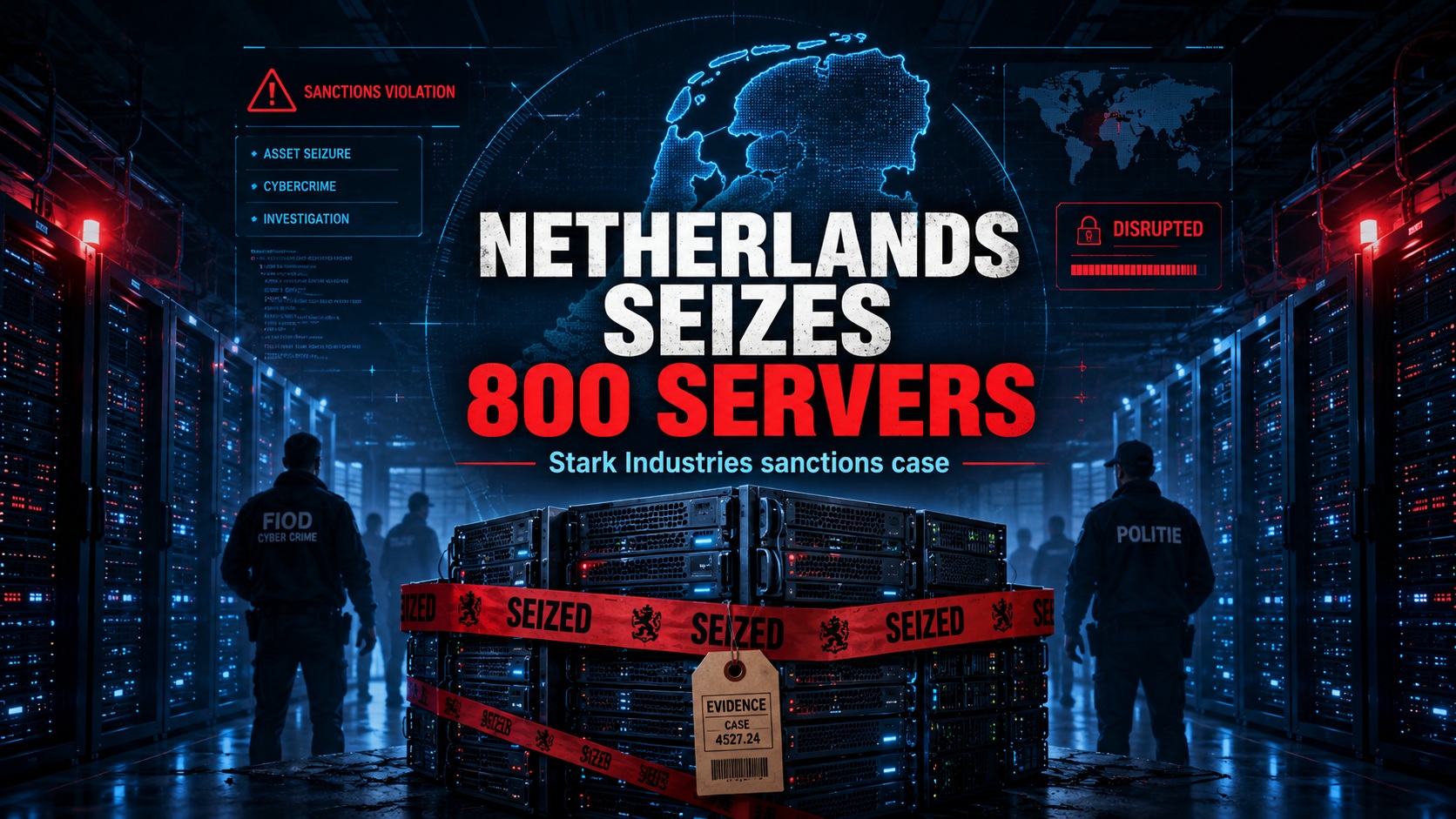
Dutch financial crime investigators have seized more than 800 servers in a major enforcement action tied to Stark Industries Solutions, a hosting network accused by European authorities of supporting Russian-linked cyberattacks, interference operations, and disinformation campaigns.
The case has also drawn attention across the LowEndTalk community, where members are already discussing the impact on affected providers, upstream networks, THE.Hosting, Mirhosting, and the broader implications for the hosting industry. You can follow that discussion here: Netherlands seizes 800 servers of hosting firm enabling cyberattacks on LowEndTalk.
According to the Dutch Fiscal Information and Investigation Service, known as FIOD, investigators arrested a 57-year-old man from Amsterdam and a 39-year-old man from The Hague on May 18, 2026. They are suspected of violating Dutch sanctions law by directly or indirectly making economic resources available to entities sanctioned by the European Union.
The enforcement action included searches at three business premises in Enschede and Almere, along with raids at two data centers in Dronten and Schiphol-Rijk. Authorities seized administrative records, laptops, phones, and more than 800 servers.
The Stark Industries Connection
The investigation centers on a web hosting company created on February 10, 2022, roughly two weeks before Russia’s invasion of Ukraine. Authorities say that in the years that followed, the company was used to facilitate destabilizing activity directed at the European Union, including cyberattacks, interference campaigns, and the spread of disinformation.
That company has been identified in reporting as Stark Industries Solutions, a hosting operation long scrutinized by security researchers and threat intelligence firms. Stark infrastructure has appeared in reporting around pro-Russian cyber activity, including DDoS campaigns by NoName057(16), as well as infrastructure allegedly used by other malicious actors.
The company’s founders, Ivan and Yuri Neculiti, Moldovan brothers from the Transnistria region, have also been linked in prior reporting to PQ Hosting and related hosting operations. PQ Hosting has been discussed for years in the context of high-risk or abuse-tolerant infrastructure, and the EU later sanctioned PQ Hosting and the Neculiti brothers over alleged support for Russian hybrid warfare activity.
The Rebrand That Did Not Solve the Problem
The most important part of this story may not be the server seizure itself, but the alleged attempt to continue operating after sanctions were imposed.
The European Union added Stark Industries to its sanctions list on May 20, 2025. Around that same period, according to FIOD, a significant portion of the technical infrastructure connected to the sanctioned company was moved to a newly created Dutch company. Investigators say that new company was not truly independent, but instead functioned as a cover for the sanctioned entities.
Reporting has identified that Dutch company as WorkTitans B.V., operating under the THE.Hosting brand. According to KrebsOnSecurity, assets tied to Stark were transferred to thehosting, controlled through WorkTitans, after news of the sanctions began circulating. Krebs also reported that WorkTitans was controlled by Youssef Zinad, the 57-year-old suspect, and that its connectivity depended on MIRhosting.
FIOD’s statement says the 39-year-old suspect controlled another Dutch company that played a facilitating role by connecting the servers of the new company to the internet. Reporting has identified that company as MIRhosting, operated by Andrey Nesterenko.
In plain English: investigators appear to be arguing that the names changed, but the operation did not.
Why This Matters to the Hosting Industry
For the hosting industry, this case is a reminder that infrastructure providers are no longer viewed as passive pipes when sanctioned entities, repeat abuse networks, or state-linked operations are involved.
That does not mean every provider is responsible for every bad customer. Legitimate hosting companies deal with abuse every day, and even well-run networks can receive complaints involving phishing, scanning, malware, DDoS activity, or compromised servers. The difference here is scale, persistence, and alleged continuity after sanctions.
FIOD is not merely claiming that bad actors used a hosting network. The agency says the infrastructure supported actions by the Russian Federation that undermine democracy and security, including information manipulation and disruption of public and economic systems. That takes the matter far beyond routine abuse desk work.
It also puts upstreams, colocation providers, transit providers, and related infrastructure partners on notice. If a sanctioned provider reappears under a new entity, with similar hardware, similar customers, similar IP space, similar routing, or the same practical operators behind the curtain, regulators may not accept “new company, new brand” as a complete answer.
LowEndTalk Community Reaction
The LowEndTalk thread on this story quickly turned into a broader discussion about THE.Hosting, PQ Hosting, Mirhosting, upstream dependencies, and what happens when law enforcement seizes physical servers from a data center.
Some members focused on the alleged rebrand and continuity of operations. Others discussed the practical impact on customers and downstream providers that may have used the affected networks as upstream infrastructure. There was also debate about whether seized servers are destroyed, returned, or eventually auctioned after a case concludes.
That community discussion is worth reading because it reflects how the hosting market processes these events in real time. LowEndTalk members often spot operational details, routing relationships, provider dependencies, and customer impact faster than mainstream coverage does.
Follow the thread here: Netherlands seizes 800 servers of hosting firm enabling cyberattacks on LowEndTalk.
The Larger Message
The Stark Industries case shows how sanctions enforcement is becoming a serious operational risk in the hosting world.
A provider can change its name. It can move customers. It can shift infrastructure to a new company. It can claim new ownership or a fresh start. But if investigators can show continuity through hardware, routing, control, customers, payment flows, or operational behavior, the rebrand may not matter.
For legitimate hosts, the takeaway is simple: know your customers, respond to abuse, document your actions, and take sanctions exposure seriously. For upstream providers and data centers, the lesson is even sharper. When a customer has already been publicly tied to sanctioned activity, cyberattacks, or state-linked abuse, continuing to provide the transport layer may create legal risk of its own.
The outcome of the Dutch case remains uncertain. The Neculiti brothers were not reported among those arrested in this action, and the suspects who were arrested remain entitled to a legal defense. But the seizure of more than 800 servers sends a clear signal: European authorities are willing to treat hosting infrastructure as a central part of cyber and sanctions enforcement, not merely as background plumbing.
LowEndBox is a go-to resource for those seeking budget-friendly hosting solutions. This editorial focuses on syndicated news articles, delivering timely information and insights about web hosting, technology, and internet services that cater specifically to the LowEndBox community. With a wide range of topics covered, it serves as a comprehensive source of up-to-date content, helping users stay informed about the rapidly changing landscape of affordable hosting solutions.


At LowEndBox, our News and Editorial Team is dedicated to delivering timely, accurate, and actionable content tailored to the needs of developers, hosting enthusiasts, and infrastructure professionals. We curate, report, and analyze the latest developments in the world of hosting, cloud infrastructure, data centers, open-source platforms, and internet services, always with a focus on value, performance, and accessibility.
Our team monitors the global hosting landscape to bring you breaking news, vendor updates, platform changes, market trends, and expert insights. Whether it’s a price hike from a major control panel, a breakthrough in virtualization technology, or a new indie provider shaking up the market, we strive to deliver content that empowers the LowEnd community to stay informed and ahead of the curve.
We also collaborate closely with the vibrant LowEndTalk community to surface meaningful discussions, highlight real-world deployments, and share voices from within the ecosystem.
Our mission is simple: to help you make smarter infrastructure decisions by delivering the stories that matter, clearly, consistently, and without hype.
Stay tuned for fresh editorial content, in-depth analyses, and community-powered features from the team that keeps LowEndBox running.


















Glad the authorities are taking action against issues like this.