


 LowEndTalk member @forest shared an interesting technique to enable AES-NI even when the provider doesn’t pass it through.
OpenSSL can read an environment setting which will use the host CPU’s AES-NI code, even if the provider presents a generic, non-AES CPU. Why? As @forest puts it:
…all QEMU does is change the effect of the CPUID instruction to stop advertising AES-NI support. But the AES-NI instructions can’t be trapped, so they’ll always work if the guest attempts to issue them and the hardware supports them.
If you have a bleeding-edge kernel, you can add a line to the kernel’s command line. I don’t have anything quite that bleeding edge, but I spun up a Debian 13 VPS in my home Proxmox environment to test it.
The host CPU is an Intel i5-8250. Flags:
flags : fpu vme de pse tsc msr pae mce cx8 apic sep mtrr pge mca cmov pat pse36 clflush dts acpi mmx fxsr sse sse2 ss ht tm pbe syscall nx pdpe1gb rdtscp lm constant_tsc art arch_perfmon pebs bts rep_good nopl xtopology nonstop_tsc cpuid aperfmperf pni pclmulqdq dtes64 monitor ds_cpl vmx est tm2 ssse3 sdbg fma cx16 xtpr pdcm pcid sse4_1 sse4_2 x2apic movbe popcnt tsc_deadline_timer aes xsave avx f16c rdrand lahf_lm abm 3dnowprefetch cpuid_fault epb pti ssbd ibrs ibpb stibp tpr_shadow flexpriority ept vpid ept_ad fsgsbase tsc_adjust bmi1 avx2 smep bmi2 erms invpcid mpx rdseed adx smap clflushopt intel_pt xsaveopt xsavec xgetbv1 xsaves dtherm ida arat pln pts hwp hwp_notify hwp_act_window hwp_epp vnmi md_clear flush_l1d ibpb_exit_to_user
I created a VM and turned off AES:
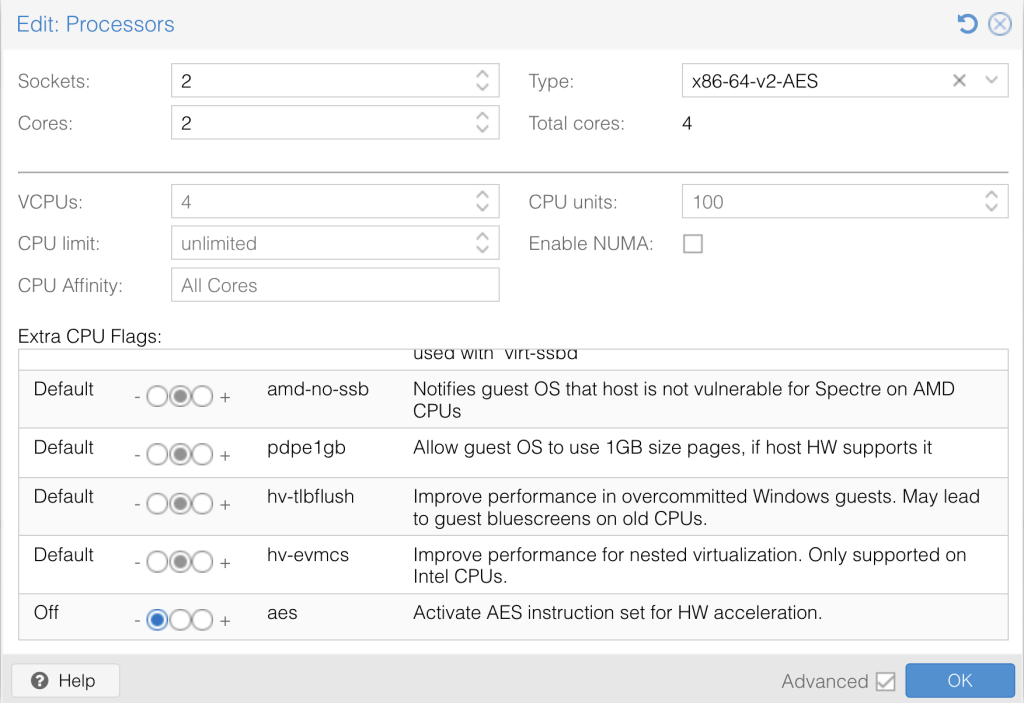
After booting, /proc/cpuinfo shows:
processor : 0
vendor_id : GenuineIntel
cpu family : 15
model : 107
model name : QEMU Virtual CPU version 2.5+
stepping : 1
microcode : 0x1
cpu MHz : 1799.997
cache size : 16384 KB
physical id : 0
siblings : 2
core id : 0
cpu cores : 2
apicid : 0
initial apicid : 0
fpu : yes
fpu_exception : yes
cpuid level : 13
wp : yes
flags : fpu de pse tsc msr pae mce cx8 apic sep mtrr pge mca cmov pat pse36 clflush mmx fxsr sse sse2 ht syscall nx lm constant_tsc nopl xtopology cpuid tsc_known_freq pni ssse3 cx16 sse4_1 sse4_2 x2apic popcnt hypervisor lahf_lm cpuid_fault pti
bugs : cpu_meltdown spectre_v1 spectre_v2 spec_store_bypass l1tf mds swapgs itlb_multihit mmio_unknown bhi its
bogomips : 3599.99
clflush size : 64
cache_alignment : 128
address sizes : 40 bits physical, 48 bits virtual
power management:
Or more simply:
root@cheyenne:~# grep aes /proc/cpuinfo
root@cheyenne:~#
Now, I set the environment variable (see LowEndTalk) in DefaultEnvironment in /etc/systemd/system.conf and export it in /etc/profile. This doesn’t put the aes flag into /proc/cpuinfo (you’d need Linux >= 6.15 for that to work, and this Deb 13 only has 6.12) but openssl noticed the difference.
I conducted a test, running
openssl speed -evp aes-128-gcmwhere OpenSSL know about the AES-NI change, and
OPENSSL_ia32cap="~0x200000200000000" openssl speed -evp aes-128-gcmto disable it. Here’s the results when OpenSSL doesn’t know AES-NI is available, expressed as 1000s of bytes per second processed.
type             16 bytes     64 bytes    256 bytes   1024 bytes   8192 bytes  16384 bytes
AES-128-GCM      23742.96k    54507.56k   161768.36k   223708.50k   248173.91k   253700.78k
AES-128-GCM      22595.02k    56259.63k   163820.29k   217182.55k   249061.38k   252952.58k
AES-128-GCM      25263.70k    57340.35k   157953.79k   219676.67k   251308.09k   251346.94k
AES-128-GCM      25034.56k    54598.95k   154434.90k   229229.23k   251330.56k   253542.40k
AES-128-GCM      24268.28k    54054.95k   149522.18k   221888.51k   249987.07k   250609.44k
AES-128-GCM      22205.23k    54394.26k   154687.40k   221060.44k   246680.23k   250631.51k
AES-128-GCM      23914.66k    56894.49k   163471.87k   225880.41k   253856.43k   252706.82k
AES-128-GCM      22851.15k    58245.33k   155108.35k   226806.44k   251527.17k   251964.07k
AES-128-GCM      22334.89k    58429.91k   153731.50k   226722.13k   247305.56k   244110.68k
AES-128-GCM      22744.85k    58385.28k   161000.62k   222503.59k   247987.46k   246721.19k
And when OpenSSL does know about AES-NI:
type             16 bytes     64 bytes    256 bytes   1024 bytes   8192 bytes  16384 bytes
AES-128-GCM      39364.50k   137706.85k   274209.88k   395095.38k   429694.98k   426306.22k
AES-128-GCM      41216.78k   140006.89k   287575.13k   404291.24k   443310.08k   445923.33k
AES-128-GCM      47618.55k   138826.41k   297024.94k   393789.78k   435423.91k   441821.87k
AES-128-GCM      47737.88k   145784.13k   276959.91k   398552.75k   431426.22k   441969.32k
AES-128-GCM      44153.77k   135803.56k   264861.44k   376348.67k   424419.33k   412259.67k
AES-128-GCM      49602.42k   136317.44k   283622.83k   403563.18k   435680.60k   443973.63k
AES-128-GCM      45073.05k   142177.83k   299664.55k   401787.90k   445480.96k   447321.43k
AES-128-GCM      43739.06k   127955.88k   287771.31k   382980.44k   426344.45k   430096.38k
AES-128-GCM      44878.53k   139109.03k   279658.41k   395250.35k   439675.56k   445360.81k
AES-128-GCM      47816.07k   141160.49k   286757.55k   395026.43k   443569.49k   445169.66k
So nearly a 2x improvement!
Related Posts:
Forgot Your Root Password? Here's the Easy Way (and the Hard Way) to Recover It
Make Your VPS Reactive: Easily Write Scripts that Fire Automatically When Filesystem Events Occur wi...
The Era of Vibe-Coded Operating Systems is Upon Us
Yeee-ouch! Guest-to-Host Escape Vulnerability in Linux KVM/x86
Vaya con Dios, strncpy
How to Speed Up Your Software RAID Resyncs - Thanks, LowEndTalk!

raindog308 is a longtime community LETizen, technical writer, and self-described techno polymath. With deep roots in the *nix world, he has a passion for systems both modern and vintage, ranging from Unix, Perl, Python, and Golang to shell scripting and mainframe-era operating systems like MVS. He’s equally comfortable with relational database systems, having spent years working with Oracle, PostgreSQL, and MySQL.
As an avid user of LowEndBox providers, raindog308 runs an empire of LEBs, from tiny boxes for VPNs, to mid-sized instances for application hosting, and heavyweight servers for data storage and complex databases. He brings both technical rigor and real-world experience to every piece he writes.
Beyond the command line, raindog308 has a life-long love of German Shepherd Dogs, high-quality knives, target shooting, theology, tabletop RPGs, playing guitar, and hiking in deep, quiet forests.
His goal with every article is to help users, from beginners to seasoned sysadmins, get more value, performance, and enjoyment out of their infrastructure.
You can find him daily in the forums at LowEndTalk under the handle @raindog308.























Leave a Reply