


 I’ve always been fond of code-writing games. I was an avid Core War player in the 90s, for example, and I learned Redcode (the x86-ish assembler used in the game) before I learned x86 assembler. Writing code in a sandbox with “real game consequences” is a great way to learn the fundamentals of problem-solving via programming.
A few years ago I crossed paths with TIS-100, a fun game where you write assembler to solve various problems. The machine you’re working on is quite different than the typical x86 box. It’s a series of interconnected nodes that can pass data through ports, and each has its own accumulator and secondary register.
Here’s an example of the game interface. I took this screenshot on an iPad, but it’s available on Steam (for Windows and Linux) as well.
And I just noticed it’s 50% off at present! Here in the US, it’s only $3.49 through July 9
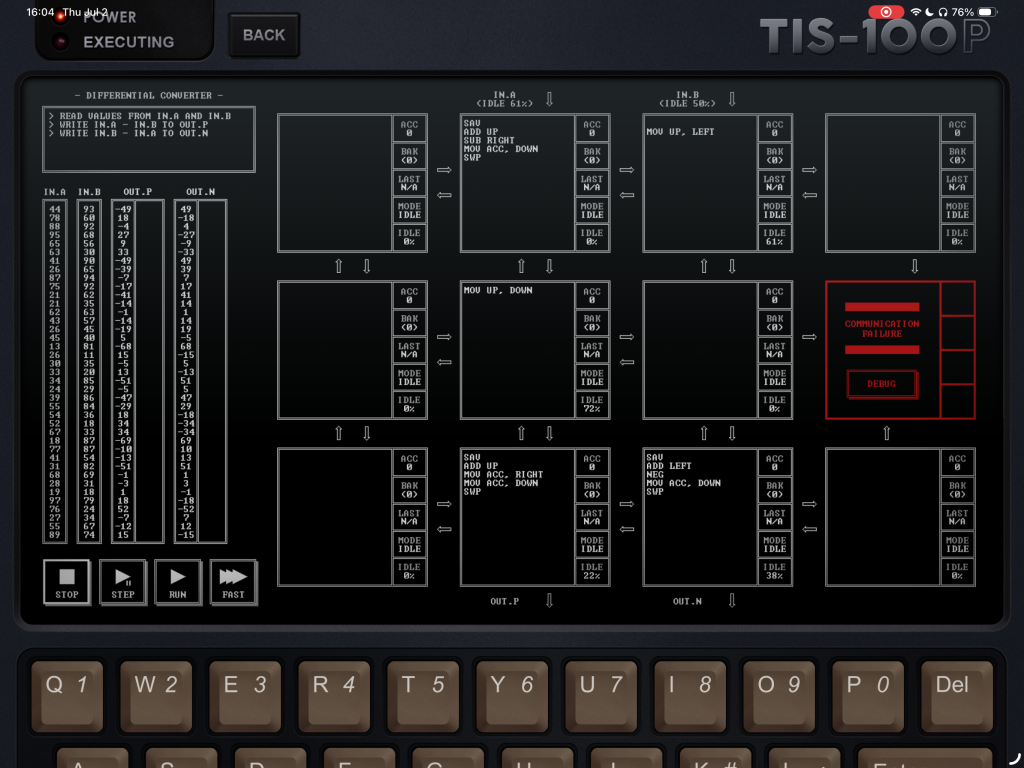
If you tap into any of the nodes, the full keyboard is brought up.
The progresses through a series of problems. This is one of the simpler ones – you’re reading values and writing them to different outputs. Here’s what a run looks like:
You can read the full manual for the game here. The assembly language is small. Besides labels and comments, there are only 13 commands.
Here’s an example program:
START:
  MOV UP, ACC
  JGZ POSITIVE
  JLZ NEGATIVE
  JMP START
POSITIVE: MOV ACC, RIGHT
  JMP START
NEGATIVE: MOV ACC, LEFT
  JMP START
If you’ve done any assembly programming, you’ll probably understand that. If not, consider that
- “JGZ” is “Jump if Greater Than Zero”
- “JLZ” is “Jump if Less Than Zero”
- Both of those operate based on the value of ACC. So if the value of ACC is 8, and you say “JGZ”, then it will jump.
- “JMP” is an unconditional jump
There is, of course, an over-arching story, but the joy is in working through the problem solving. Enjoy!
Related Posts:
LowEndGaming: Walkabout Mini Golf Course Tier List (Updated!)
Watch Out for Nukes, Tovarich! Game Review: Misery, the Post-Apocalyptic Extraction Indie Shooter
LowEndGaming: A Different Walkabout Mini Golf Tier List From raindog308's Daughter
LowEndGaming: Walkabout Mini Golf Course Tier List
raindog308's Civilization VI Big Bucks Strategy Guide
The Worst Game on Steam Has Overwhelmingly Positive Reviews

raindog308 is a longtime community LETizen, technical writer, and self-described techno polymath. With deep roots in the *nix world, he has a passion for systems both modern and vintage, ranging from Unix, Perl, Python, and Golang to shell scripting and mainframe-era operating systems like MVS. He’s equally comfortable with relational database systems, having spent years working with Oracle, PostgreSQL, and MySQL.
As an avid user of LowEndBox providers, raindog308 runs an empire of LEBs, from tiny boxes for VPNs, to mid-sized instances for application hosting, and heavyweight servers for data storage and complex databases. He brings both technical rigor and real-world experience to every piece he writes.
Beyond the command line, raindog308 has a life-long love of German Shepherd Dogs, high-quality knives, target shooting, theology, tabletop RPGs, playing guitar, and hiking in deep, quiet forests.
His goal with every article is to help users, from beginners to seasoned sysadmins, get more value, performance, and enjoyment out of their infrastructure.
You can find him daily in the forums at LowEndTalk under the handle @raindog308.
























Leave a Reply