


 Recently, Tailwinds – makers of the popular CSS framework – announced they were laying off 75% of their engineering staff. In absolute numbers, that’s only three people, but for a company that had 8 people to lay off 3, that’s still a huge impact.
The reason: AI. But not exactly what you think.
We’ve covered “AI layoffs” before. There are very few “AI took my job” stories that bear close examination. In many cases, layoffs at big tech firms are not about robots doing the work humans used to do, but rather that management is spending so much money on AI build-outs that they are under financial pressure to cut costs.
But this is something different. According to the Tailwinds CEO:
Traffic to our docs is down about 40% from early 2023 despite Tailwind being more popular than ever. The docs are the only way people find out about our commercial products, and without customers we can’t afford to maintain the framework.
Quoting a news article on this development:
According to Wathan, Tailwind usage is “growing faster than it ever has” but revenue is down by almost 80 percent. The reason he gave is that use of AI tools and agents means traffic to the documentation on the website has dropped by 40 percent in two years, meaning developers do not discover the commercial plans which sustain the business.
Intermediation Now
The issue is AI putting up a barrier between the company and its customers. With an AI assistant, it’s entirely possible to use Tailwinds without ever visiting the maker’s web site or using the docs. It’s certainly plausible that someone could watch few Tailwinds tutorials on YouTube, and then turn to their favorite AI IDE plugin and say “here’s what I want from Tailwinds” and the maker is entirely out of the loop.
There are plenty of other examples. For example, StackOverflow’s traffic is now equal to the same traffic they had the month they launched.
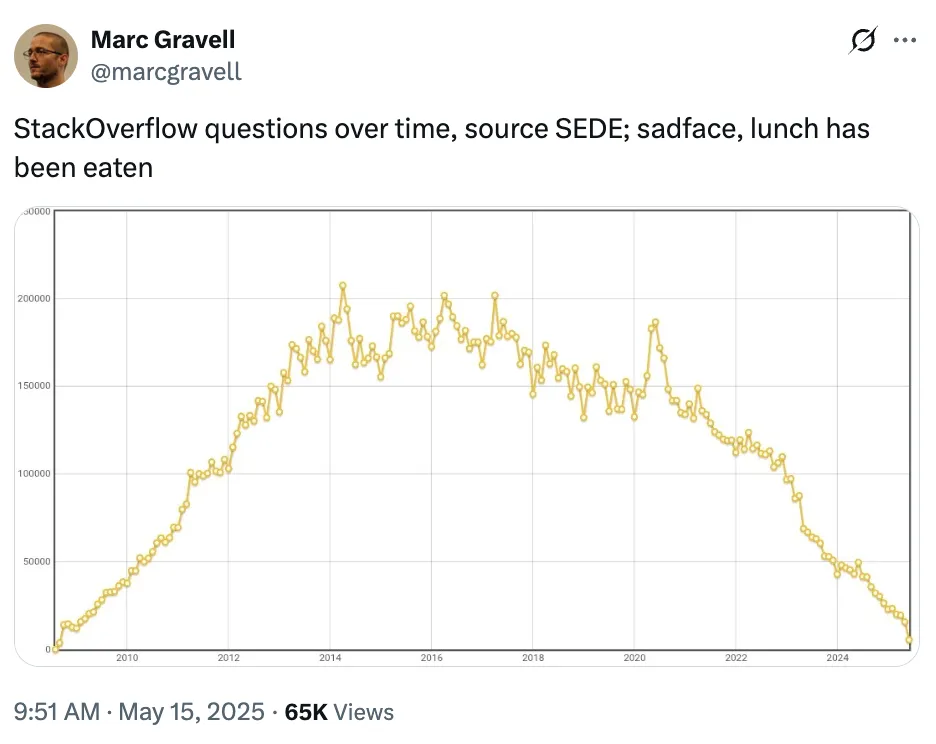
The idea of asking a question and then checking back in a day to see if (1) some moderator hasn’t decided it’s unworthy, and (2) some other human has taken the time to answer it seems very quaint now. With AI, I get an answer in seconds, and I don’t have to deal with SO mods. AI has effectively inserted itself between me and SO because it has all of the SO data, so…why do I need to go to SO? To see ads?
Or how about this recently post from LaraCasts, which laid off 40% of its staff:
In it, the LaraCasts CEO talks a lot of about his personal coding experience with AI, but seems to miss the point that LaraCasts itself is going to be come obsolete. Today, it’s still wise to have a senior dev review AI-generated code, but even now that doesn’t always happen, and soon it will probably not be necessary. Who needs LaraCasts then?
Intermediation in the Future
Now let’s talk about the bigger implications. Big Tech is pushing this vision where you and I have agents to do everything and shopping is often one of those use cases.
Recently, I’ve been shopping for a wallet. I take my EDC gear very seriously so I’ve been reading reviews, browsing makers’ web sites, watching YouTube videos, reading Reddit threads, etc.
But in the shining future when agentic AI is everywhere, an AI would be doing all this. I’d say to it “I want a wallet with features X and Y” and it would ask me some questions (e.g., “how many cards do you carry”, “do you need a money clip”, etc.) and it would then go out and do all of this work and come back and say “You want the ExampleCorp SuperWallet 2000”.
ExampleCorp has no chance to tell me their story, entice me with discounts, or offer other products. They’re simply a listing in a giant planetscale catalog of goods that can be purchased.
This is true for services as well. “AI, I want a savings account with a minimum of X% interest that doesn’t require more than $X000 to open”. “Sure, raindog308, here’s a link to ExampleBank with their Premier Savers Account that pays…”
This information is being fed from two sources: the plantetscale catalog that says “we have wallets with these specifications” and “we have bank accounts with these terms,” but also reviews from many sources that say “ExampleCorp wallets are awesome” and “ExampleBank has horrible customer service.”
But these review sources often depend on revenue. Sure, there are people who’ll buy a product and create a YouTube video and say “I love this wallet,” but so much of the review content on YouTube is created in the hopes of monetization or sponsorship. All that goes away if the vast majority of views are by AI. Yes, the planetscale catalog might tell you “80% of reviews are five-star” but I get a lot out of reading actual reviews, not just by sorting by star rating.
AI is poised to insert itself between vendor and buyer, service provider and customer, human endeavor and human being. This delegation is already having effects, but is poised to be a much bigger disruption.
Related Posts:
PortableMind: The Offline AI on a USB You Can Run on Your Laptop - Privacy, Survival Info, and More!
How to Get Sued Into Oblivion: Guardian Angel AI
The Famous Pick-Up Artist Who Picked Up...a Bot?
The Economics of AI and Why Cost-Conscious Companies Hate It
What Will Be the Sixth Epoch of Computing?
Is LowEndBox Written by AI? No!

raindog308 is a longtime community LETizen, technical writer, and self-described techno polymath. With deep roots in the *nix world, he has a passion for systems both modern and vintage, ranging from Unix, Perl, Python, and Golang to shell scripting and mainframe-era operating systems like MVS. He’s equally comfortable with relational database systems, having spent years working with Oracle, PostgreSQL, and MySQL.
As an avid user of LowEndBox providers, raindog308 runs an empire of LEBs, from tiny boxes for VPNs, to mid-sized instances for application hosting, and heavyweight servers for data storage and complex databases. He brings both technical rigor and real-world experience to every piece he writes.
Beyond the command line, raindog308 has a life-long love of German Shepherd Dogs, high-quality knives, target shooting, theology, tabletop RPGs, playing guitar, and hiking in deep, quiet forests.
His goal with every article is to help users, from beginners to seasoned sysadmins, get more value, performance, and enjoyment out of their infrastructure.
You can find him daily in the forums at LowEndTalk under the handle @raindog308.























Leave a Reply