


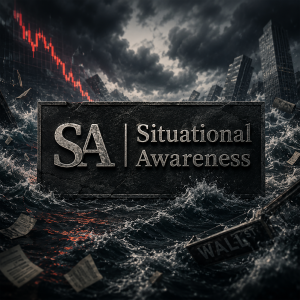
 Back in 2024, Leopold Aschenbrenner published Situational Awareness, which we here at LowEndBox termed “The Best Read of the Year”.
And it was. It talked about many tropes that have since become mainstream, such as
- AGI and ASI
- The intelligence explosion
- The AI national security race
- Trillion-dollar clusters
None of these ideas was new to SA, but it presented them in an extensive, free PDF with lots of beautiful graphs and made them very accessible. Aschenbrenner was a former OpenAI alignment team member, which gave him an insider’s credibility, at a time when OpenAI was the face of AI to the public.
True, some of these things are like Terminator fan fiction, and the piece falls prey to the toddler growth fallacy. If a human grows from 19 inches to 30 inches in three years, then in ten years he’ll be a giant, right? Of course not, but that kind of logic pervades prognostications about the iterations of LLMs on the path to ASI.
I think today the Situational Awareness piece is best looked at as a summary of a certain kind of AI maximalist thinking, rather than a reliable guide to the future.
Aschenbrenner launched this publication at the same time he started his hedge fund, also called Situational Awareness. For a while it was flying high, but this week it cratered, selling all of its assets at distressed prices to Citadel (another hedge fund). Losses are reported at 67%. What went wrong?
Before we get to that, it’s worth pointing out two facts:
- Leopold Aschenbrenner has exactly zero experience managing money. People go to graduate school and study money management as a profession for years before they become junior analysts, much less hedge fund founders. Aschenbrenner has a B.A. in mathematics and economics.
- Aschenbrenner has exactly zero experience in computer science. He worked for OpenAI for one year on its “super alignment” team, where he fed tales of how AI could take over the world into LLMs to see what they’d say.
The Three Sins
Aschenbrenner’s fund was all-in on AI. This is not unusual in the sense that many funds focus on specific sectors. Tech is particularly popular but there are funds who specialize on energy, shipping, or whatever.
In the case of Situational Awareness, the first problem was that they were long on AI. They concentrated on companies that were suppliers of AI compute: chips, datacenters, etc. Unfortunately, these companies – such as Nebius, Sandisk, CoreWeave, et many al. – have declined sharply. Examples:
- On June 25, Sandisk closed at $2418 a share. Today it is below $1300.
- Corewave hit $128 in May. Today you can buy a share for $72.
- Nebius went from $285 to $190 in the same time frame.
- And Bloom Energy sunk from $348 to $167.
The second problem was that Situational was short on software. They bought into the “Saaspocalypse” narrative, which hasn’t worked out well. While many software companies such as Adobe and Salesforce were down earlier this year, the idea that AI is going to replace all software is laughable.
Think about the idea: instead of signing up for Salesforce, you’ll give Claude a prompt to create a CRM for you. Claude can probably create a workable skeleton CRM, but not something with all of Salesforce’s features and integrations. And the software isn’t really the main thing you’re buying. If you’re a large company, you want support, regular maintenance, and help integrating it with all your other computing needs. Claude is not going to provide that. Adobe and Salesforce aren’t going anywhere.
Salesforce, Adobe, and other software companies have rebounded at the same time the AI bets were declining. In short, Situational’s longs went short and its shorts went long. Didn’t this hedge fund hedge at all?
The final sin was that Situational Awareness went all in by highly leveraging its bets. In other words, it took on debt to fund them – to the tune of 4x leverage, which is very high. Leverage is like pouring nitrous oxide into your engine – it amplifies everything. But of course, that works in both directions. As Charlie Munger put it, “Smart men go broke three ways: liquor, ladies, and leverage.”
Currently, Situational Awareness’ value has dropped from $45bn to a reported $10bn, but that is probably a considerable exaggeration. The fund is going to close and Aschenbrenner will need to find a new job.
At least the next time, he won’t have to admit he had no prior experience in the financial sector.

raindog308 is a longtime community LETizen, technical writer, and self-described techno polymath. With deep roots in the *nix world, he has a passion for systems both modern and vintage, ranging from Unix, Perl, Python, and Golang to shell scripting and mainframe-era operating systems like MVS. He’s equally comfortable with relational database systems, having spent years working with Oracle, PostgreSQL, and MySQL.
As an avid user of LowEndBox providers, raindog308 runs an empire of LEBs, from tiny boxes for VPNs, to mid-sized instances for application hosting, and heavyweight servers for data storage and complex databases. He brings both technical rigor and real-world experience to every piece he writes.
Beyond the command line, raindog308 has a life-long love of German Shepherd Dogs, high-quality knives, target shooting, theology, tabletop RPGs, playing guitar, and hiking in deep, quiet forests.
His goal with every article is to help users, from beginners to seasoned sysadmins, get more value, performance, and enjoyment out of their infrastructure.
You can find him daily in the forums at LowEndTalk under the handle @raindog308.




















Leave a Reply