


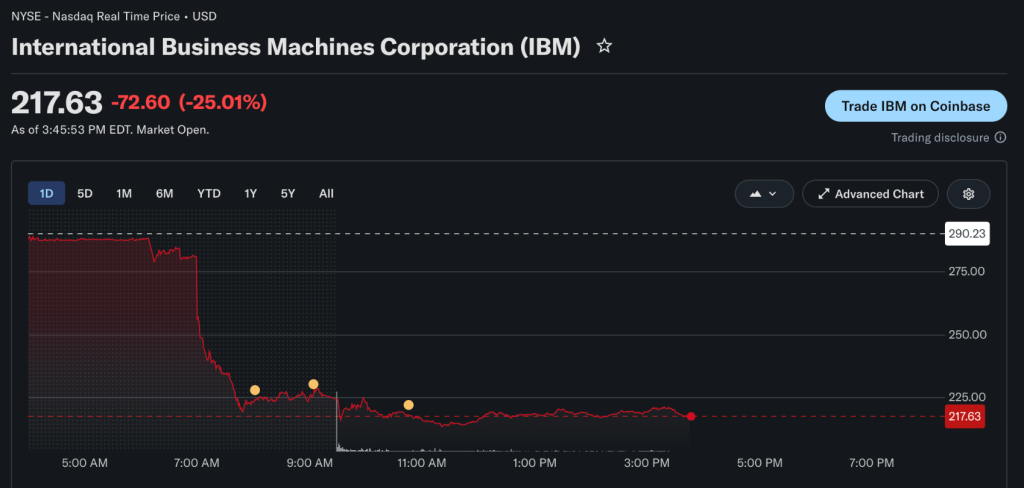
 On July 14, 2026, IBM’s shares tanked.
And by “tanked” I mean “dropped 25% in a single day”.
For a company with a $200bn+ market cap that’s breath-taking. IBM IPO’d on November 11, 1915 and in the century since, IBM has never dropped by anything like that in a single day. Not during two World Wars, the Great Depression, or innumerable market calamities over the span of 111 years.
The reason for the fall was the perception that IBM’s clients were shifting their spend to focus on AI-enabling hardware rather than IBM’s pricey software. It was a sort of “micro-Saaspocalypse”. While few truly believe that AI is going to start spitting out enterprise accounting and CRM systems any time soon, analysts did conclude that given the choice to spend precious budget dollars on GPUs versus more IBM enterprise software and consulting services, CIOs would choose the former.
So if you’re the IBM CEO, what do you do to direct attention away from this calamity?
That’s easy – you talk up your whiz bang technology in other areas.
Yesterday, IBM’s CEO made two statements in an interview:
- Quantum computing will have “a measurable impact” on IBM’s top and bottom line by 2028 or 2029.
- “By the end of the 2030s, we are now pretty convinced this is a trillion dollars of value.”
Are either of these statements likely to be true?
Measurable Impact
The first statement is rather vague. Accountants can measure to the penny, but let’s assume he means something that will actually move the needle. According to our AI overlords, the entire global market for AI in presently around $1.3 billion.
IBM’s TTM revenue is about $69bn. So even if the market was double estimates and IBM capture 100% of it (which won’t happen), that’s less than a 4% tick up.
Is that “measurable”? Sure…but not exactly a hypergrowth story.
That’s not to downplay that or say it’s not worth mentioning, but it’s an abuse of the poorly-defined word “measurable”. When most people hear that word, they hear “substantial”. IBM’s CEO is aware that the word could mean that, but that it also could mean “enough to show up”. It’s a great word to imply something grander than what you actually think will happen, yet still not lie.
Trillion Dollar Baby
Now what about that second statement? A “trillion dollars in value” by the end of the 2030s. We’re going to take that literally as 2039, but the real thing to focus on is “value”.
Is that…
- Annual sales by IBM in the quantum computing market?
- The entire quantum computing market”
- Annual economic value created?
- Cumulative economic value created?
You can see the difference. Adding $1 trillion in annual sales (the first bullet point) by IBM in quantum computing would be nothing short of breath-taking. There’s no company today does $1 trillion in annual sales (Amazon and Wal-Mart are both at about $700 billion), let alone in a single computing category. But that last bullet point could mean every penny of economic value ever created by quantum computing – which might mean very little to IBM’s financial performance.
For example, an IBM client might spend $20 million on quantum computing to produce $10 billion in revenue. Are we counting the $20 million in sales or the $10 billion in client sales?
But here’s something more significant: current estimates say that the market for quantum computing is about $1.3 billion. Consulting giant McKinsey puts it at a more generous $4 billlion. They predict a $72 billion market by 2035.
Even taking McKinsey’s more generous estimate, reaching $1 trillion by 2039 would require the industry to grow almost 14-fold in four years, or about 93% annually. IBM’s trillion-dollar figure is between 14 and 50 times analyst’s most optimistic projections.
Is There Cause for Optimism?
Sure! Quantum computing continues to develop. Scientists have continued to knock down error-correction hurdles and the technology is constantly improving. Less than 30s years ago, a two-qubit prototype was the best labs could mange. Today we are on the threshold of quantum supremacy for some applications. There’s every reason to think that quantum computing could be a significant technology in future datacenters.
But boiling all of that down to a specific company’s bottom line, as IBM’s CEO attempted to do, is more about trying to distract you from a company that isn’t faring well in the market. Be hopeful about quantum computing, but don’t necessarily expect IBM to start minting billionaires.
Related Posts:
The Post-Quantum Era Begins in 2029
Hey raindog308, That TK5 Article Didn't Work on Debian! (Here's the Fix)
The Free $8 Million Mainframe is Now Updated and Better Than Ever!
CLONE WARS: How Every Major RHEL Clone is Reacting to IBM, From Counter-Exploiting Legal Loopholes t...
Rocky Linux is Back in the RHEL Clone Business Due to a Clever Legal Hack
IBM Kneecaps Alma Linux, Rocky Linux, and Other RHEL Clones

raindog308 is a longtime community LETizen, technical writer, and self-described techno polymath. With deep roots in the *nix world, he has a passion for systems both modern and vintage, ranging from Unix, Perl, Python, and Golang to shell scripting and mainframe-era operating systems like MVS. He’s equally comfortable with relational database systems, having spent years working with Oracle, PostgreSQL, and MySQL.
As an avid user of LowEndBox providers, raindog308 runs an empire of LEBs, from tiny boxes for VPNs, to mid-sized instances for application hosting, and heavyweight servers for data storage and complex databases. He brings both technical rigor and real-world experience to every piece he writes.
Beyond the command line, raindog308 has a life-long love of German Shepherd Dogs, high-quality knives, target shooting, theology, tabletop RPGs, playing guitar, and hiking in deep, quiet forests.
His goal with every article is to help users, from beginners to seasoned sysadmins, get more value, performance, and enjoyment out of their infrastructure.
You can find him daily in the forums at LowEndTalk under the handle @raindog308.























Honestly, I like to buy when big tech companies hit a low. I bought Intel, AMD, and (happily) NVIDIA when their stocks were plummeting. I’m more of a tech geek than a traditional investor, but as a geek, I knew those three wouldn’t stay down forever—the hardware demand cycle would inevitably shift. Those bets have paid off, especially NVIDIA and now Intel.
But looking at IBM’s recent stock drop, I just don’t have the itch to buy. Could it be a mistake? Maybe. But my perspective is shaped by being a big Linux and open-source fan who has spent years working with small and medium-sized businesses. From where I sit, IBM’s reliance on complex enterprise licensing, legacy mainframes, and heavyweight consulting feels completely antiquated compared to modern tech powerhouses like Google, Apple, Anthropic, or OpenAI.
IBM deserves credit for pivoting as long as they have—especially by acquiring Red Hat to stay relevant—but their whole way of doing business in today’s tech landscape feels foreign to me. When hardware companies drop, you can count on the next compute cycle to trigger a violent rebound. But with IBM and similar legacy software/services giants, I just don’t ‘feel’ that same bounce-back energy. I’d rather put my money into companies building the raw engine of the future than those managing enterprise legacy systems.”
Solid thinking. IBM is a mixture of gnarly old enterprise software, legacy mainframe, legacy Unix, consulting, outsourcing, and then a few cutting-edge things like quantum. Besides being hard to value, where is their focus? I think they ride on the momentum of their decades of Fortune 500 relationships.