


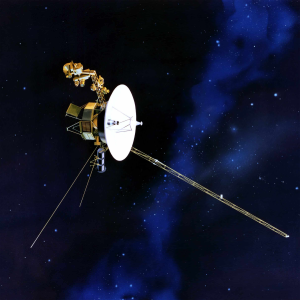
 Voyager 1 and Voyager 2 were launched in 1977 and are two of a handful of spacecraft that have entered interstellar space. Two others (Pioneer 10 and Pioneer 11) were launched several years earlier are now derelict and out of communication with the Earth, while New Horizons is much newer, having been launched in 2006.
The Voyager series have onboard computers that are beyond ancient by modern standards. There are a set of interconnected systems, which combined – combined! – have 32KB of memory. From this, they power an array of scientific instruments and communicate with Earth. They are custom hardware, not off-the-shelf electronics, and hold the world records for the oldest continuously-running computers, having been powered-on nonstop since 1977. The CPUs operate at about 250Khz, which is four times slower than a Commodore 64.
There isn’t really an operating system per se, but rather a set of different integrated circuits to do specific things. The design is more like a constellation of Arduino boards than a Raspberry Pi.
One interesting thing is that there’s no encryption or authentication per se. Voyager was designed in the 1970s. It does not have something analogous to:
HMAC(command, secret_key)
where the spacecraft cryptographically proves that NASA authorized the command.
This raises the obvious question: why hasn’t Voyager been hacked?
The Hurdles
First, an attacker would have to get the signal to either Voyager, which isn’t trivial. A nation state could do it, but the average Joe would need to have a lot of money to build a very large, very accurate transmitter. The spacecraft is billions of miles away, and the legitimate signal has to be carefully pointed and modulated. A person on Earth could certainly build a transmitter capable of putting energy into the relevant frequency, but this is more of a billionaire’s secret black project than something a kid puts together from mail-order electronics.
NASA’s Deep Space Network communicates with Voyager using enormous antennas and very sensitive receivers. The spacecraft’s own transmitter is only around the tens-of-watts range, but the DSN is specifically engineered to work with an incredibly weak signal.
For an attacker to inject commands successfully, they would need to transmit a signal that the spacecraft’s receiver would actually recognize as a command. And because the spacecraft is thousands of millions of miles away, this isn’t like attacking a satellite in low Earth orbit.
You’d need:
- the correct frequency, modulation, data rate, etc.
- the correct command protocol, spacecraft addressing
- sufficient transmitter power and an accurate antenna pointing directly at a tiny object billions of miles from Earth
- knowledge of the spacecraft’s current command state/protocol
Of course, getting a signal into the DSN and having the DSN send for you would be an easy path, but there you’re facing modern cybersecurity (and probably an air gap). Also, sending from the DSN to Voyager isn’t something that’s done frequently. When it lights up to send a signal, a lot of people notice.
You also have to know the command format. There isn’t a language like this:
TURN ENGINE ON
The commands are encoded into a specific telemetry/command protocol and transmitted at the appropriate data rate and modulation. NASA’s command system used highly structured command sequences, with spacecraft-specific addressing and validation mechanisms. This is to filter out random radio noise or interference, but it also means that any message must be precise and accurate.
In fact, what you’d send are assembly language commands. You can find an emulator here, which shows how NASA communicates with Voyager. It’s not sending TURN ENGINE ON, it’s commands like these:
MLD VAL2 ; Load $55AA into RA (while still in lower bank)
Getting hold of the published specs from 1977 isn’t hard. Knowing what the state of the systems are in 2026 so your command isn’t rejected as invalid is impossible.
Is Hacking Voyager Possible?
The security model isn’t “cryptographically prove that this command came from NASA.”
It’s “only someone with an extraordinarily capable ground station who knows how to speak Voyager’s command language is realistically going to be able to do this.”
Could, for example, a nation state like Russia or China (or France or the UK or Japan) hack Voyager? I don’t see why not. They have the technology and resources. Of course, there’s zero motivation for them to do it. All such an attack would accomplish is to make the US and the global scientific community mad. The only people who would have a motivation are nihilists and attention-seeking hackers, and they don’t have the resources.
So Voyager is safe because the protection is more about the scale a hacker needs than any specific security protocols.

raindog308 is a longtime community LETizen, technical writer, and self-described techno polymath. With deep roots in the *nix world, he has a passion for systems both modern and vintage, ranging from Unix, Perl, Python, and Golang to shell scripting and mainframe-era operating systems like MVS. He’s equally comfortable with relational database systems, having spent years working with Oracle, PostgreSQL, and MySQL.
As an avid user of LowEndBox providers, raindog308 runs an empire of LEBs, from tiny boxes for VPNs, to mid-sized instances for application hosting, and heavyweight servers for data storage and complex databases. He brings both technical rigor and real-world experience to every piece he writes.
Beyond the command line, raindog308 has a life-long love of German Shepherd Dogs, high-quality knives, target shooting, theology, tabletop RPGs, playing guitar, and hiking in deep, quiet forests.
His goal with every article is to help users, from beginners to seasoned sysadmins, get more value, performance, and enjoyment out of their infrastructure.
You can find him daily in the forums at LowEndTalk under the handle @raindog308.






















Leave a Reply